

Thickeners in Food Processing: Key Roles & Types
Jan 23, 2025
Food thickeners are one of the most important auxiliary materials in the food industry. They contribute significantly to food texture, stability, and overall product quality. Food thickeners help ensure consistency and enhance the sensory experience of food products by improving mouthfeel, viscosity, and appearance.
The role of thickeners is not limited to just thickening but extends to various functional properties that influence how food behaves during preparation, processing, and storage. This article mainly focuses on the main roles of thickeners in food processing and recommendations for common thickeners.
Key Roles of Thickeners in Food
1. Thickening, Dispersion, and Stabilization
Food thickeners are typically hydrophilic macromolecules. When dissolved in water, they greatly increase viscosity, giving the system a thickened feel. As the viscosity of the system increases, the dispersed phase is less likely to aggregate or coagulate, thus stabilizing the dispersed system. Most thickeners also act as surfactants, adsorbing onto the surface of the dispersed phase, making it more hydrophilic and helping it evenly disperse in aqueous systems.
2. Gelation
Some thickeners, such as gelatin and agar, form viscous fluids when heated. As the temperature decreases, the molecules connect to form a network structure, trapping the solvent and other dispersed media within the structure, resulting in a non-flowing semi-solid (gel). Many food processes take advantage of this property, such as in the making of jelly, custard, etc.
3. Clarification and Coagulation
Most thickeners are high-molecular substances. Under certain conditions, they can simultaneously adsorb multiple dispersed media, causing them to aggregate and be separated, thus achieving purification or clarification. For example, adding a small amount of gelatin to juice can help clarify the juice.

4. Water Retention
The hydrophilic properties of thickeners can improve the quality of meat and dough products. In dough-based foods, thickeners can enhance water absorption, helping water penetrate protein molecules and starch granules during dough mixing, improving the mixing process. Due to their gelling properties, thickeners also enhance the elasticity and elasticity of dough-based products, increase the degree of starch gelatinization, and make them less prone to aging and drying out.
5. Controlling Crystallization
The use of thickeners can endow foods with a higher viscosity, so that no crystal precipitation occurs in supersaturated solutions or systems, or the crystallization achieves a refinement effect. For example, controlling the sand-returning phenomenon of syrup products and inhibiting the appearance of ice crystals in ice cream products.
6. Film-Forming and Preservation
Food thickeners can form a smooth protective film on the surface of food, preventing exposure to oxygen and microorganisms. This helps prevent the quality of frozen foods and solid powdered foods from deteriorating due to moisture absorption on the surface.
7. Foaming and Foam Stability
Thickeners can aid in foaming, forming network structures. When used in cakes, bread, ice cream, and other products, thickeners like carrageenan, guar gum, sodium alginate, and gelatin help increase foam volume and stabilize foam. For example, the foam in beer and the "lace" on the bottle walls are the result of thickeners being used.
8. Adhesive Properties
In sausages, guar gum and carrageenan are used to help bind the product into a cohesive form. After homogenization, the product maintains a stable, lubricated structure and utilizes the thickener's strong water-retention properties to prevent weight loss during storage. Arabic gum is also used as a binder for tablets, granules, and powdered foods, in the pelletizing of food ingredients, spices, and other applications.
Recommended Common Thickeners
Sodium Carboxymethyl Cellulose (CMC)
Sodium carboxymethyl cellulose is water-soluble, highly stable, and acid-resistant. Due to its excellent properties, CMC thickener is widely used in the processing of beverages, ice cream, cakes, and many other foods to perform thickening, emulsifying, and stabilizing functions.

Xanthan Gum
Xanthan gum is a polysaccharide thickener. It has high viscosity even at low concentrations and remains stable over a wide range of temperatures and pH levels. Xanthan gum thickener is commonly used in sauces, dairy products, and meat products to enhance texture and mouthfeel, giving the product a unique quality.
Gelatin
Gelatin is one of the most commonly used natural thickeners. Extracted from animal skins and bones, it has excellent gelling properties. Gelatin is essential in the making of jellies, puddings, and other foods. It gives the product good elasticity, gloss, and enhances both appearance and mouthfeel.
Carrageenan
Carrageenan is widely used in dairy products, meat products, and beverages. It effectively thickens and provides a good gel structure. It is also commonly used in vegetarian and dairy-free products as a gelling agent alternative.
Pectin
Pectin is a natural polysaccharide extracted from citrus peels and apple pomace. It is commonly used in jams, jellies, and candies to form gels by reacting with sugars and acids. Pectin thickener can form gels at relatively low temperatures and enhances the transparency and gloss of the product.
Soy Lecithin
Lecithin is commonly used as a thickener in dairy products and baked goods. It not only acts as a thickener but also plays a key role in emulsification, helping to blend oil and water and maintain the stability of food products.
Conclusion
Proper selection and use of thickeners are crucial for improving food quality and market competitiveness. Food manufacturers need to choose the right thickener based on the characteristics of different foods and their specific needs, bringing higher-quality food products to consumers.
At CHEMSINO, we offer high-quality and diverse thickeners that deliver consistent performance across various food applications. Contact us today to find the perfect solution for your needs and boost the quality of your products. Our team is ready to assist you with fast delivery and competitive prices.
You Might Also Like
-

Glyceryl Monolaurate GML 90% CAS NO. 142-18-7
-

China Preservative Manufacturing Natamycin CAS No.:7681-93-8
-

Food Additives Personal Care Products CAS NO.26402-22-2
-
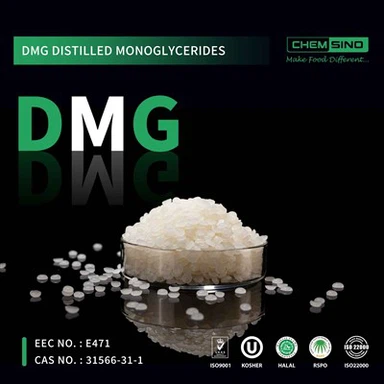
Food Additives Distilled Monoglycerides DMG Tablets CAS N...
-

Polycerol Esters Of Fatty Acids PGE Powder And The Benefi...
-

Sodium Benzoate E211 Preservative in Skincare And Food