

DMG vs GMS: Differences in Composition and Food Applications
Nov 05, 2026
Glyceryl Monostearate (GMS) and Distilled Monoglycerides (DMG) are widely used emulsifiers in the food industry. Both belong to the E471 family, but their composition and monoglyceride content can be quite different.
The main difference is that conventional GMS grades may contain a mixture of monoglycerides and diglycerides, while DMG undergoes an additional purification process to achieve a higher monoglyceride concentration.
This difference affects their functionality in food formulations, particularly in bakery products, ice cream, margarine, and other fat-containing foods. Understanding how they differ can help manufacturers select the right emulsifier for their production needs.
What Are GMS and DMG?
GMS, or Glyceryl Monostearate, is a fatty acid ester of glycerol, mainly associated with stearic acid. Commercial GMS products may contain different proportions of monoglycerides and diglycerides, depending on the manufacturing process and product grade.
GMS is commonly used to improve emulsification, modify fat structure, and maintain product consistency. It is available in different commercial grades, such as GMS 40, GMS 60, and higher-purity products.
DMG, or Distilled Monoglycerides, is produced by further purifying mono- and diglycerides, commonly through molecular distillation. This process increases the concentration of monoglycerides while reducing the proportion of diglycerides and other glycerides.
Most commercial DMG products contain around 90% or more monoglycerides. Because of this higher concentration, DMG is often selected for formulations that require more concentrated and consistent emulsifier functionality.
It is worth noting that DMG is not a completely different chemical family from GMS. Both are based on glycerol fatty acid esters and are generally classified as E471. The key distinction is their composition and level of purification.
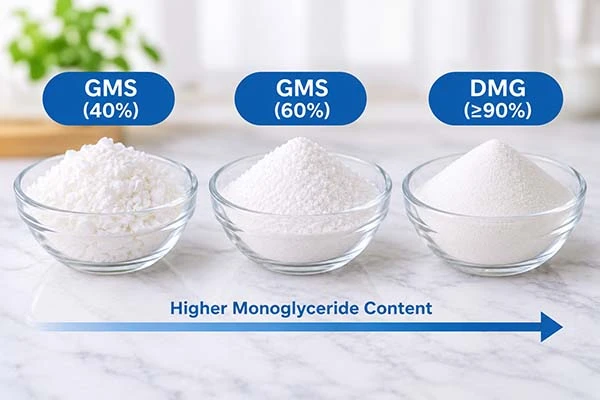
DMG vs GMS: What Is the Difference in Composition?
Monoglyceride content is the most important parameter when comparing conventional GMS with distilled monoglycerides.
For example, a GMS 40 grade contains approximately 40% monoglycerides, while GMS 60 contains approximately 60%. In comparison, DMG 90 typically provides at least 90% monoglycerides, subject to the manufacturer's specification.
|
Parameter |
GMS 40/60 |
DMG 90 |
|
Main component |
Mono- and diglycerides |
High concentration of monoglycerides |
|
Monoglyceride content |
Approximately 40–60% |
Typically 90% or higher |
|
E-number |
E471 |
E471 |
|
Production |
Esterification or glycerolysis |
Further purification, commonly molecular distillation |
|
Main advantage |
Versatile and economical formulation option |
Higher and more concentrated monoglyceride content |
|
Typical applications |
Bakery, fats, creams |
Bread, cakes, ice cream, and other formulated foods |
These figures are representative commercial grades rather than fixed specifications for every manufacturer.
Higher monoglyceride content does not automatically mean better performance in every application. The fatty acid composition, physical form, melting behavior, and processing conditions also influence the final result.
How Does Monoglyceride Content Affect Food Performance?
The higher monoglyceride concentration in DMG can make a practical difference in food processing.
Monoglycerides contain both a hydrophilic glycerol group and a lipophilic fatty acid chain. This molecular structure allows them to interact with oil and water, helping improve emulsification and ingredient distribution.
They can also interact with starch and fats, which is particularly important in bakery and frozen dessert applications. In bread production, for example, monoglycerides can form complexes with amylose, a component of starch. This interaction helps slow starch retrogradation, one of the main processes responsible for bread becoming firm during storage.
DMG is often preferred when manufacturers need a concentrated source of monoglycerides for this purpose. GMS can provide similar functionality, but the amount of active monoglycerides delivered at the same dosage may be lower.
In fat-based products, both GMS and DMG can influence fat structure and texture. Their performance depends on the composition of the fat phase and the physical properties of the emulsifier. Therefore, selecting the right grade is more important than simply choosing the product with the highest monoglyceride content.
DMG vs GMS in Food Applications
The differences become clearer when looking at how these emulsifiers are used in actual food production.
Bakery: Bread and Cakes
Bakery is one of the major application areas for distilled monoglycerides. In bread, DMG helps interact with starch and can delay crumb firming, allowing bread to maintain a softer texture during storage.
In cake formulations, monoglycerides can support batter aeration and help produce a finer crumb structure. They also contribute to the stability of fat-containing systems.
GMS is another practical option for bakery manufacturers, particularly when moderate monoglyceride content is sufficient for the formulation.
Ice Cream
Ice cream production requires careful control of fat destabilization, air incorporation, and texture.
Monoglycerides help promote controlled fat destabilization during freezing and whipping. This supports air-cell structure and contributes to the body and texture of the finished product.
DMG is commonly used in ice cream formulations because of its high monoglyceride concentration. However, the final performance also depends on the fat content, stabilizer system, processing conditions, and other ingredients.
Margarine and Shortening
In margarine and shortening, emulsifiers help control fat structure, consistency, and the distribution of ingredients.
Both GMS and DMG can be used in these formulations. GMS offers a practical option for general emulsification and fat modification, while DMG provides a higher concentration of monoglycerides.
The best choice depends on the desired product texture, fat composition, and processing requirements.

Can DMG Replace GMS?
DMG can replace GMS in many food formulations, but the two products should not be substituted at the same dosage without testing.
Consider a formulation that uses 1% GMS 40. This provides approximately 0.4% monoglycerides in the finished formulation. Replacing it with 1% DMG 90 would provide approximately 0.9% monoglycerides.
That is more than twice the monoglyceride contribution, which may change the emulsification performance, texture, and processing behavior.
For this reason, manufacturers should adjust the dosage according to the required functionality rather than simply replacing one product with another on a weight-for-weight basis.
Comparing the technical specifications and conducting production trials are the most reliable ways to determine a suitable replacement level.
Final Thoughts
GMS and DMG are both E471 food emulsifiers, but their different monoglyceride concentrations give them different formulation characteristics.
Conventional GMS grades are suitable for a wide range of food applications where moderate monoglyceride content is sufficient. DMG, with its higher purity, is particularly useful in formulations that require concentrated monoglyceride functionality, such as bread, cakes, and ice cream. The right choice depends on the food application, required functionality, and processing conditions.
CHEMSINO supplies GMS and Distilled Monoglycerides (DMG) for food manufacturers worldwide. If you are looking for a suitable emulsifier for your bakery, dairy, or fat-based products, contact us at for product specifications and technical support.
Frequently Asked Questions
1. Is DMG the same as GMS?
Not exactly. Both belong to the E471 family, but DMG is further purified to achieve a higher monoglyceride concentration. Conventional GMS grades generally contain different proportions of mono- and diglycerides.
2. What is the difference between GMS 40 and DMG 90?
The main difference is monoglyceride content. GMS 40 contains approximately 40% monoglycerides, while DMG 90 typically contains 90% or more. This means DMG provides a more concentrated source of monoglycerides.
3. Why is DMG commonly used in bread production?
DMG can interact with starch to form amylose-lipid complexes, helping slow starch retrogradation and delay bread firming. This helps maintain crumb softness during storage.
4. Can GMS and DMG both be used in ice cream?
Yes. Both can be used in ice cream formulations. DMG is often selected for its higher monoglyceride concentration, while the final choice depends on the required fat destabilization, texture, and overall formulation.
5. What is the typical purity of DMG?
Commercial distilled monoglycerides commonly contain around 90–95% monoglycerides. The exact content should always be confirmed through the manufacturer's technical data sheet or Certificate of Analysis.
You Might Also Like
-

China Emulsifier Manufacturing Lactic Acid Esters Of Mono...
-
Admul Datem E472e in Bread
-

Thickener Carrageenan Gum In Milk E407 CAS:9000-07-1
-
Innovative Polycerol Esters Of Fatty Acids PGE Powder
-

E475 Emulsifier Polyglycerol Esters Of Fatty Acids Halal ...
-

Food Grade CITREM E472c For Bakery, Confectionery, And Be...